What Is Rewarded User Acquisition? A 2026 Guide for Growth Teams
Rewarded user acquisition (rewarded UA) acquires real users by paying them in-app rewards for completing offers. Learn how it works, why it beats pure CPI, and how to run it with an offerwall.

Rewarded user acquisition — "rewarded UA" — is one of the most efficient ways to grow a mobile app in 2026, because it pays for engaged users instead of empty installs. This guide explains what it is, how it works end to end, and how to run it without the integration headache.
What rewarded user acquisition actually means
Rewarded UA is a performance-marketing channel where users are paid in in-app rewards for completing an advertiser's offer. The reward is virtual currency, coins, or gift-card points inside the app the user is already using; the offer is something an advertiser wants done — install an app, sign up, start a trial, reach a level.
It's the modern, cleaned-up version of what used to be called incentivized traffic. The difference today is the discipline around it: CPA/CPE goals, server-side verification, and fraud controls that make the users measurable and real.
How it works, end to end
- An advertiser posts an offer with a cost-per-action payout — "$3 per sign-up", "$2 per install to level 5".
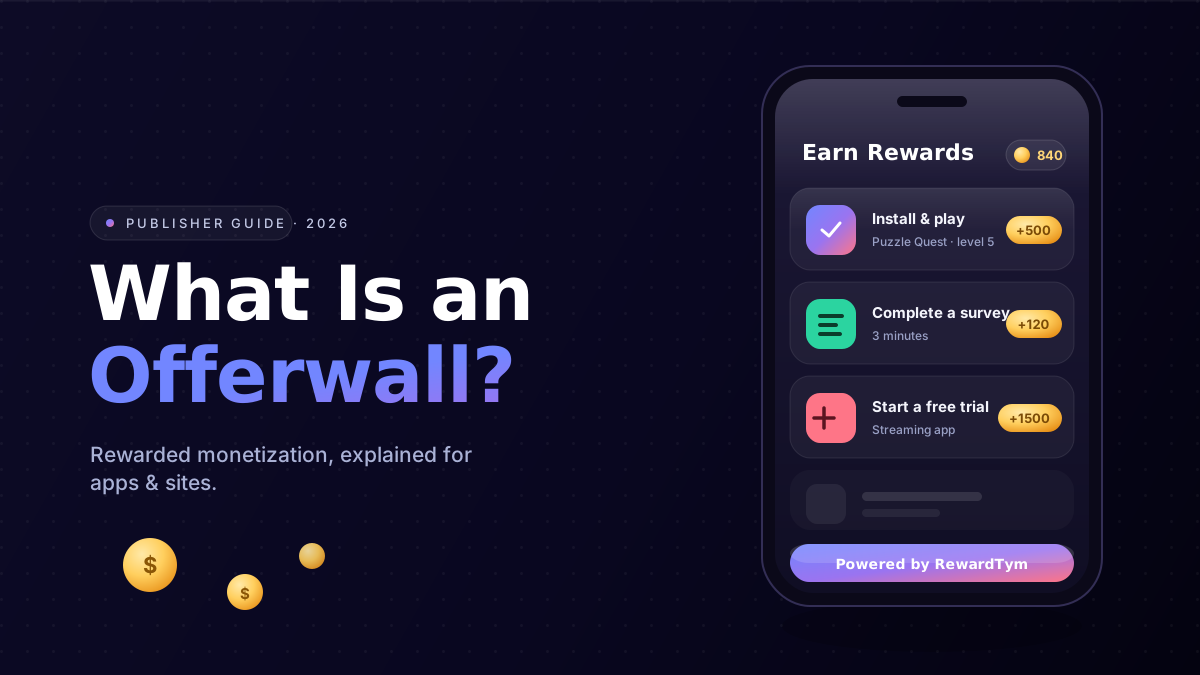
- Publishers surface the offer inside their apps, usually through an offerwall.
- A user opts in and completes the action for an in-app reward.
- A server-to-server postback verifies completion before anyone is billed.
- The advertiser pays, the publisher rewards the user and keeps the margin.
Everyone is aligned: the advertiser pays for results, the publisher earns revenue, and the user gets something they wanted.
Why rewarded UA beats pure CPI
The problem with buying installs is that an install is a shallow signal — plenty of installed apps are never opened again. Rewarded UA, built on CPA and CPE goals, only pays when the user does something meaningful.
Rewarded UA for both sides of the market
If you're an advertiser, rewarded UA gives you measurable, opt-in users on CPA/CPI/CPE terms, with postback verification so you pay for real actions.
If you're a publisher, rewarded UA is a monetization channel: you give your users rewards they want, and earn the margin on every verified completion.
Pros
- Pay for engaged users, not empty installs
- Lower fraud exposure with CPA/CPE + postbacks
- Opt-in, so it's retention-positive
- Works for advertisers (growth) and publishers (revenue)
Cons
- Needs an offer source and distribution — i.e. a network
- Requires fraud controls to keep quality high
How to run it without the headache
The simplest way to run rewarded UA is through an offerwall network that already connects advertisers and publishers. Historically that meant integrating a native SDK. A hosted offerwall removes that step — embed with a URL or iframe and a postback, and you're live.
Bottom line
Rewarded user acquisition grows apps by paying users to take real actions, verified by postback and priced on CPA/CPE — so you get engaged users and lower fraud instead of hollow installs. An offerwall network is how you run it, and a hosted one is how you run it fast.
Want to acquire users or monetize your traffic with rewarded UA? Get started with RewardTym.
This guide reflects standard 2026 performance-marketing practice from independent sources; specific rates, quality and outcomes vary by campaign, geo, vertical and offer mix.
Frequently asked questions
What is rewarded user acquisition?
Rewarded user acquisition (rewarded UA) is a performance-marketing channel where users are paid in in-app rewards — currency, coins, gift-card points — for completing an advertiser's offer, such as installing an app, signing up, or reaching an in-app milestone. The advertiser pays on a cost-per-action basis, the publisher rewards the user and keeps the margin, and completion is verified by a server-to-server postback.
Is rewarded user acquisition the same as incentivized traffic?
Yes — rewarded UA is the modern name for incentivized user acquisition. Users opt in and are rewarded for completing actions. Done well, with CPA/CPE goals and fraud controls, it delivers engaged, measurable users rather than empty installs.
Why use rewarded UA instead of standard CPI campaigns?
Standard CPI pays for installs, which can include users who never return. Rewarded UA built on CPA and CPE goals only pays when a user takes a meaningful action or hits an in-app milestone, so you filter out low-quality installs, cut fraud exposure, and spend on users who actually engage.
How do I run rewarded user acquisition?
The simplest path is an offerwall network. As an advertiser, you post offers with CPA/CPI/CPE payouts and the network distributes them across publisher apps; as a publisher, you embed the offerwall and reward your users. A hosted offerwall like RewardTym lets you start without a native SDK.
Ready to monetize with RewardTym?
Join publishers and advertisers growing revenue in the rewarded economy.
Get started free →